How a Busy Mum of Three Found Healing Through Upcycling Furniture and Art Projects

The kitchen table had become a command centre: school letters, half-finished toast, crayons with no wrappers, a glue stick without a lid, and a mug of tea gone cold again. For a busy mum of three, there was rarely a clean surface, let alone a quiet hour.
Somewhere between packed lunches, sensory meltdowns, lost PE kits, bedtime battles, and the constant hum of family life, she had started to feel like she had disappeared inside everyone else’s needs.
Then an old bedside table changed things.
It was scuffed, wobbly, and destined for the tip. She dragged it into the corner of the room, wiped it down, and painted one drawer during a rare pocket of calm. It was not a grand creative plan. It was not a business idea. It was simply something she could finish.
That small act became a turning point. Upcycling furniture and making art gave her more than a hobby. It gave her a way to breathe, process, connect with her neurodivergent child, and rebuild a sense of self in a home that often felt full to the brim.

When the house felt too loud, making gave her a place to land
Family life with three children can be beautiful, funny, and relentless. Add the needs of a neurodivergent child, and the day can carry extra layers that others do not always see.
There may be sensory needs to plan around, transitions that need careful handling, food preferences that change without warning, or school days that spill over into emotional evenings. There may be appointments, forms, guilt, advocacy, worry, and the quiet exhaustion of always being alert.
Creative work did not remove any of that. It did something different.
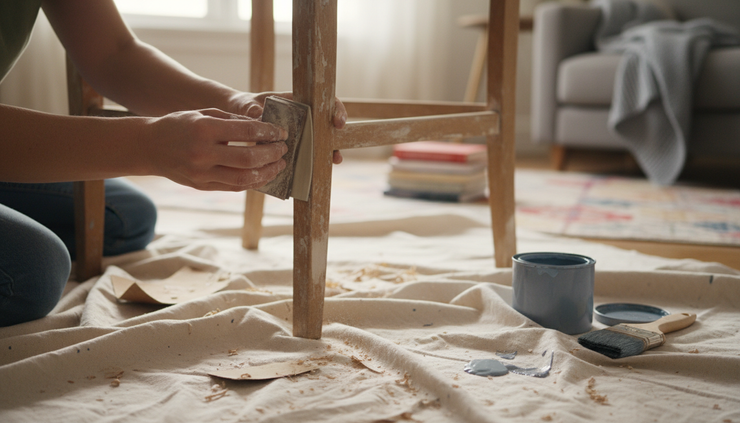
It gave this mum a small, steady place to put her attention. Sanding a chair leg, mixing a paint colour, smoothing paper onto a drawer front, or choosing fabric for a lampshade asked for focus, but not perfection. Her hands had something to do. Her mind had somewhere to rest.
That matters. Repetitive, hands-on creative tasks can feel grounding because they use the body as well as the brain. There is rhythm in brushstrokes. There is comfort in sorting buttons, fabric scraps, beads, paintbrushes, or screws. There is relief in seeing progress when so many parts of parenting feel unfinished.
Healing did not arrive as one huge breakthrough. It came in small layers of paint, glue, sanding dust, and ten-minute pauses.
This kind of making also created a rare sense of control. A child’s difficult day could not always be fixed. Sleep could not always be guaranteed. The washing pile would grow again. But a tired pine stool could become soft sage green. A chipped frame could become bright and useful. A forgotten drawer could become a place for art materials.
For someone used to solving everyone else’s problems, the furniture asked a gentler question: what would you like to make?
Upcycling worked because it fit real family life
Many hobbies demand clean space, spare money, and long stretches of time. Those things can be hard to find in a family home.
Upcycling furniture worked because it met her where she was. It welcomed scraps, interruptions, and imperfect timing. It could be done in pieces.
A cupboard door could be cleaned while the pasta boiled. Handles could be removed after bedtime. Paint could dry while snacks were made. A collage could sit unfinished for a week and still be ready when she returned to it.
The materials were often already there:
A chair from a relative’s garage
Sample paint pots left from decorating
Old wrapping paper or wallpaper offcuts
Broken jewellery saved for drawer pulls or decoration
Fabric from clothes the children had outgrown
Jars filled with buttons, shells, beads, and small treasures
The low-cost nature of upcycling eased the pressure. There was no need to buy a full set of specialist tools straight away. There was no need to create something perfect enough to sell or display. The point was to begin.
That permission to be imperfect was powerful.
Parenting can bring a constant sense of being judged, especially for parents of neurodivergent children. People may give advice without understanding the child. They may mistake overwhelm for behaviour, or routine for being too strict. They may see one difficult moment and miss the careful work behind the scenes.
Upcycling offered a space without that judgement. If the paint dripped, it could be sanded. If the colour looked wrong, it could be painted over. If the first attempt failed, the lesson stayed.
That mindset slowly moved into other parts of life. A hard day did not mean she had failed. A new strategy with her child did not have to work every time to be worth trying. Progress could be patchy and still real.
Art projects became a shared language with her neurodivergent child
One of the most meaningful changes came when her neurodivergent child began joining in.
Not every child finds it easy to explain feelings in words. Some communicate more freely through movement, pattern, colour, texture, or play. Art gave them another route.
At first, the projects were simple. Painting wooden shapes. Sorting buttons by colour. Sticking fabric onto cardboard. Making a collage from old magazines. Choosing which handle should go on a drawer.
There was no pressure to sit still for ages or follow a perfect outcome. Some days the child painted for three minutes and left. Some days they watched. Some days they wanted to mix every colour into brown. Some days they lined up paintbrushes and did not paint at all.
All of it counted.
The shared projects helped because they could be adjusted to fit sensory needs. A child who disliked sticky textures could use a brush, sponge, or glue spreader. A child who found noise hard could work in a quiet corner. A child who needed movement could paint standing up. A child who loved detail could decorate tiny sections.
The projects also made room for choice in a safe way. Would they like blue or yellow? A roller or a brush? Spots or stripes? This drawer or that one?
Small choices can feel big to children who spend much of the day coping with demands. In art, there was space to lead.
It also changed the emotional tone between parent and child. Instead of another reminder, correction, or rushed transition, they had moments side by side. No eye contact was required. No long conversation was needed. The work in front of them held the connection.
For a child who struggles after school, this kind of low-demand creative time can become a bridge. It says, I am here. We can do something together. You do not have to explain everything first.
This is not medical advice, and creative projects are not a replacement for professional support when a child or parent needs it. But in everyday family life, art can be a gentle tool for regulation, expression, and connection.
What changed inside the home and inside her
The first visible changes were practical. The home slowly filled with useful pieces that carried a story.
A scratched coffee table became a board-game table with a painted checkerboard top. A dull bookcase became a bright shelf for children’s books and sensory toys. A small cabinet became a cupboard for craft supplies. A plain frame became a display for one child’s favourite picture.
The house did not become spotless or styled like a magazine. It became more personal. More forgiving. More theirs.
There is something meaningful about repairing what already exists. A chipped chair does not have to be thrown away. A stained tabletop can still serve a family. A dresser with missing handles can become beautiful again.
That message landed deeply for her.
On harder days, she had felt worn down by the idea that everyone else was coping better. Social feeds, school-gate conversations, and family expectations can make home life look smoother than it is. Upcycling pushed back against that polished version of living.
It reminded her that broken does not mean useless. Worn does not mean finished. Messy does not mean without worth.
The projects became quiet proof that change could happen slowly.
They also gave her language for her own recovery. Healing, for her, did not mean becoming endlessly calm or suddenly having life under control. It meant noticing her own needs again. It meant making room for joy without feeling selfish. It meant finding patience for herself as well as her children.
Some weeks she finished nothing. Some weeks the paint tin stayed shut. Life still happened. Children got ill. Plans changed. The neurodivergent child needed more support. The house still became chaotic by tea time.
But the projects were waiting, and that mattered. They did not demand a perfect routine. They simply offered a way back.

Gentle ways to begin when life is already full
Starting a creative habit in a busy home can feel unrealistic. The trick is to make the first step so small it can survive ordinary family life.
A whole wardrobe makeover may be too much. One drawer is enough. A full craft room is not needed. A shoebox of supplies will do.
Try one of these simple starting points:
Paint a tired picture frame and use it for a child’s artwork
Cover a drawer front with wallpaper offcuts
Turn clean jars into brush pots, button jars, or sensory play containers
Sand and repaint a small stool
Decorate a plain wooden tray with tester-pot paint
Use fabric scraps to brighten a lampshade or noticeboard
Choose projects with low stakes. Avoid anything precious at the start. The best first item is often something that would otherwise be donated, recycled, or thrown away.
Keep supplies simple:
Sandpaper
A small brush
A cloth
Water-based paint
Child-safe glue
Old newspaper or a dust sheet
A tub or tray for unfinished pieces
For families with children, safety matters. Keep sharp tools, strong adhesives, and small choking hazards out of reach. Check paint labels. Work in a ventilated space. Let children join in at a level that suits their age and needs.
It can also help to create a project basket. This is not a perfect Pinterest-style set-up. It is just one container that holds the current project and can be moved quickly when dinner, homework, or a meltdown takes over.
A project basket might include:
One small item to work on
Two or three colours
A few brushes or sponges
Baby wipes or a cloth
A plastic mat
A notebook for ideas
This kind of set-up lowers the barrier. When a quiet five minutes appears, there is no need to search the house for supplies.
For a neurodivergent child, keep the invitation open but pressure-free. Instead of saying, “Come and make this with me,” try:
“I’m painting this drawer if you want to watch.”
“You can choose a colour if you like.”
“The sponge is here if you want a turn.”
“You can stop whenever you need to.”
Some children will join through doing. Others will join through watching, choosing, sorting, or commenting. Connection can look different from one child to another.

The healing was in the returning
What makes this story so relatable is that it never required a complete life overhaul. There was no spare room magically transformed into a studio. No sudden abundance of free time. No perfect morning routine.
There was a mum, three children, a neurodivergent child with real needs, and a home that carried the marks of daily living.
There was also a chipped bedside table.
By giving herself permission to repair, paint, glue, and play, she found a form of healing that fitted into the edges of her life. Upcycling furniture gave her visible progress. Art projects gave her a way to connect without forcing words. Together, they helped her feel less lost inside the demands of motherhood.
The lesson is not that every overwhelmed parent needs to start painting furniture. The lesson is gentler than that.
A small creative act can become a place to return to. It can remind a person that they are more than the roles they perform. It can turn scraps into something useful, and a hard season into something with colour.
Sometimes healing starts with a brush, an old chair, and ten quiet minutes while the kettle boils.
Comments